
How to tell stories online

Fellow travelers,
It’s 2026 and I’ve been writing, photographing, and traveling for more than a decade. During all that time I struggled to clearly explain what it is I’m doing, or why I insist on doing it this way. Plus I also realize that, from the outside, it can look like movement for the sake of movement. As if I’m a restless transplant looking for some belonging.
And if we're looking at the results so far, the tangible ones at least: a series of trips across the globe, an endless stream of images, a monthly newsletter that changed both shape & format numerous times in the four years since its inception. The work is there, but it feels scattered, at best.
And yet, none of this feels accidental.
The premise
It has taken some considerable time, but I noticed the wandering is not spineless. There are recurring elements, like a sequence I move through again and again. I have found the difference between wandering and working isn’t about knowing where you are headed. It’s having a structure you can return to, day after day.
So what I’ve been building isn’t a collection of trips, images, or blog posts. It’s a loop between, what I now call: the Field, the Studio, the Office, and, sometimes, the Shop.
The Field is where we collect the material. Every bit of information we can find that fuels our curiosity is stored in words, images, or other forms or recording.
The Studio is where this collection is turned into something meaningful. We comb through the images, read through the notes, digest them into something we can share.
The Office brings the structure that allows for that distribution. We maintain our website, send our newsletters, do our finances, and organize our workflows here.
The Shop makes this work formal and sustainable. It's how we generate and secure the continuity of our practice. Like an exchange between our efforts and the appreciation of the audience.
Each of these are their own domain, separated by their inherent characteristics, but also interwoven in ways where they depend on each other to make the most of each. You can think of these as structural metaphors for the different modes of work. Or, a bit more academically worded, the four cognitive environments I use to structure my work and protect the different kinds of decisions that go with them.
The practice
Look, describing a structure once you notice it (or at least think you have noticed it) is one thing. But showing it in action is perhaps even better.
My recent work from Mexico is probably the most practical example of the domains I just introduced. I went to Mexico as a tourist, not a documentarian with a thesis ready-made. But I can't help but also think of myself as some sort of 'field operative in training.' I didn't realize it at the time, but the journey itself was the field work, the culling, editing and writing each day the studio work, and making the blog posts was the necessary office work to distribute that work.


If you’ve been reading this newsletter for some time, you might've already deduced this and you know the pattern that I've been working in. Perhaps you recognize a version of it in your life. In any case, I want to take a first stab at making this thinking a little more concrete. It's a process I have been actually running for a while, and am now trying to formalize.
Below is the Field Manual I use to keep curiosity from scattering, and to move it through a repeatable and dependable sequence that turns real life experience into finished work.
The Field Manual: Telling Stories Online
What appears online as a photo, a post, or a newsletter is usually just the result of a much larger system. Beneath it runs a loop: Field. Studio. Office. Shop. Experience feeds interpretation. Interpretation feeds distribution. Distribution, if done well, feeds sustainability. This is the structure behind the work, split by domain. Loosely formulated, to serve as both reminder and inspiration on when to focus on what.
The Field
Go out. Pay attention. Collect reality.
- Be curious about the world.
- Decide something is worth investigating.
- Figure out how to capture that curiosity.
- Pick up a camera.
- Travel close to home.
- Travel far from home.
- Walk more than planned.
- Carry the camera at all times.
- Keep your setup simple, make sure the camera is the lightest it can be.
- Only shoot prime lenses.
- Only bring one camera.
- Photograph anything that crosses your path.
- Photograph what confuses you.
- Photograph what feels ordinary.
- Photograph the surprising things that look out of place.
- Train your ability to see, not just look at, the world.
- Be bad at seeing for a long time.
- Notice your shortcomings.
- Keep at it regardless.
- Eat the local food.
- Eat the wrong local food.
- Get sick.
- Go outside anyway.
- Shoot.
- Accept boredom.
- Accept discomfort.
- Miss.
- Shoot again.
- Repeat.
- Repeat.
- Repeat.
- Continue for years.
The principle: The Field generates raw material. Not clarity.
The Studio
Return. Review. Interpret.
- Respect your own time and effort in the field.
- Import your work immediately.
- Back up twice.
- Sit with what you made.
- Keep everything, also what now seem to be obvious failures.
- Study your work.
- Identify repetition.
- Identify absence.
- Ask yourself:
- What was I drawn to?
- What did I avoid?
- What changed in me?
- Use your experience to slowly figure out what you were actually seeing.
- Discover the story.
- Even if you thought you had if figured out previously.
- Don’t let your preconceptions define your outcome.
- Redefine the ‘type of photographer‘ you think you are.
- Outgrow it.
- Redefine it again.
- Land somewhere close, but not quite ‘it.‘
- Accept a permanent state of flux.
- Write the core narrative.
- Remove what sounds clever but says nothing.
- Clarify what this is actually about.
Principle: The Studio generates meaning. The story is recognized, not captured.
The Office
Structure. Publish. Maintain continuity of output.
- Become excited about posting on social media: "Look! I made a thing!" you say in different ways.
- Witness the over-saturation of 'creative work' on all platforms.
- Become disenchanted by it, perhaps even resent it sometimes.
- Do not rely solely on rented platforms like social media.
- Learn how to build a website.
- Rebuild it.
- Take ten years to find your format.
- Create the post.
- Optimize the images.
- Place the images intentionally.
- Format carefully.
- Check links.
- Publish.
- Send the newsletter.
- Accept feedback, in any shape.
- Listen to the haters.
- Ignore the haters.
- Use the feedback only when it aligns with your goals.
- Do not obsess over metrics.
- Organize your archive.
- Maintain workflows.
- Do your finances.
Principle: The Office generates distribution and structure. Visibility supports practice.
The Shop
Formalize. Exchange. Sustain.
- Notice what repeatedly resonates (insight from the Studio).
- Identify what has durable value.
- Turn ongoing practice into something finite.
- Package those insights.
- Define the offer clearly.
- Price it with intention.
- Build the checkout.
- Deliver cleanly.
- Reinvest in field work.
Principle: The Shop generates sustainability. Without exchange, the practice exhausts. With exchange, the practice compounds.
The Loop
The Loop is what holds the four domains mentioned. These domains are to be thought of in the presented order, though Studio and Office are of the same hierarchy. And albeit Studio Work can be done without Office Work, doing Office Work without prior Studio Work, while technically possible, is hollow and pointless.
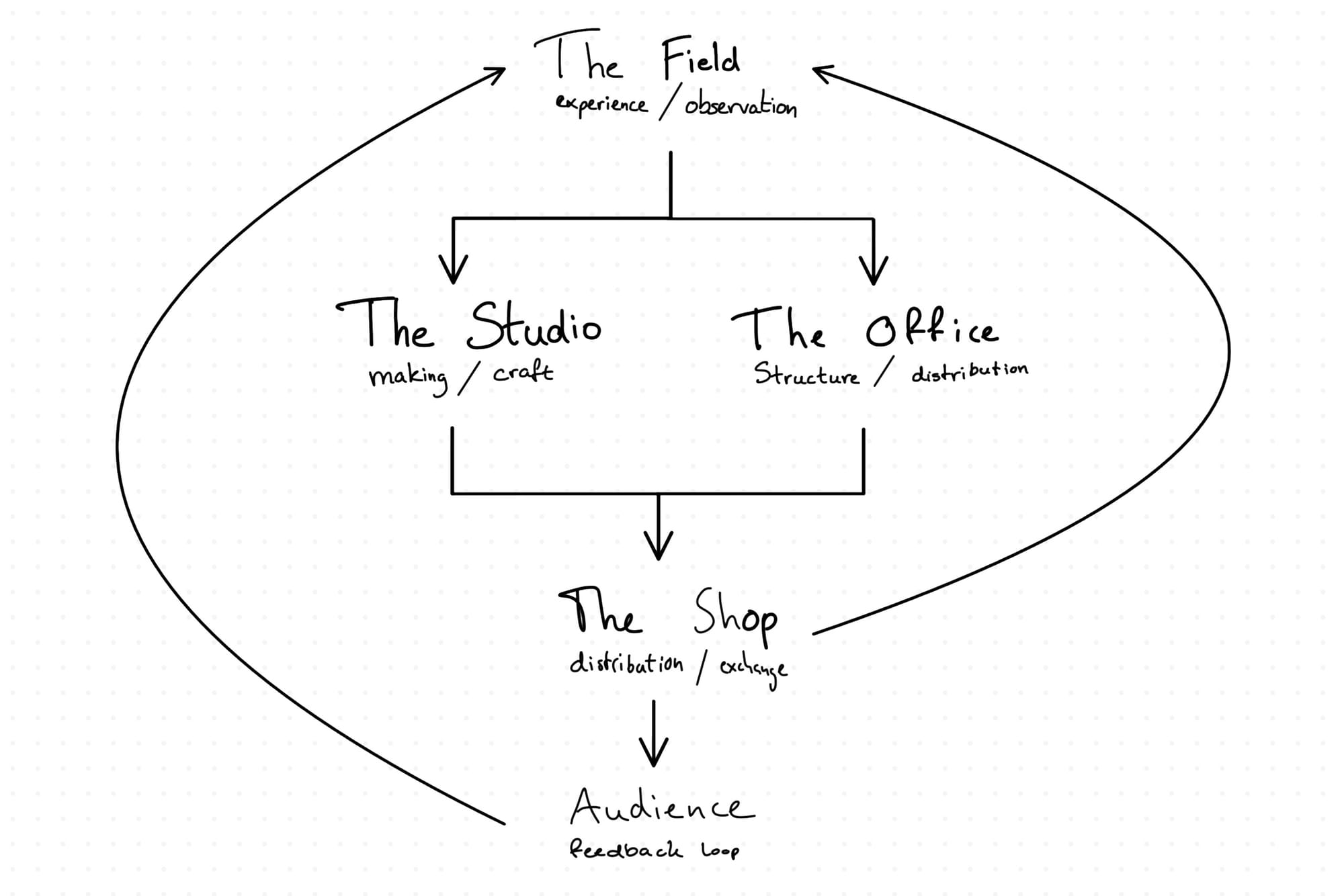
These domains are not as much about pushing yourself into formats for the sake of clarity or solely for having clear boundaries, but more about putting names and concrete understandings to abstract processes you are already doing anyway. Revealing these structures allows you to understand how much time you spend in each, and if that distribution is healthy for your practice, or not.
Your time in the Field is for gathering whatever you come across and sparks your curiosity. Time in the Studio is for finding understanding of the things you found. The Office ensures you can share that understanding. The Shop is how we monetize this work so that we can reinvest into the field work, closing the loop. As a bonus, the audience always provides some version of feedback (even zero response is a version of feedback) and you bring that with you next time you go into the Field.
Repeat until your taste sharpens.
Repeat until your identity settles.
Repeat until the infrastructure supports the work without friction.
This typically takes north of ten years and that is normal. True agency and autonomy is built through cycles, not moments.
The conclusion
This model is still forming. The lists underneath each domain are not instructions so much as an archetypal timeline of events that tend to happen there. Your version will probably look a little different. The point isn’t to follow the sequence exactly, but to recognize the pattern and adapt it to your own practice. Think of it as a mental model. A way to bring a bit of structure to a creative life that otherwise tends to scatter in a hundred directions.
So I do ask those in similar positions: does any of this make sense to you?
I’ve been thinking about loops more deliberately over the past few months, mostly because I started feeling uneasy about the imbalance in my own work. There was plenty of output in the form of trips, images, notes, and posts, but less integration than I expected. I’m very good at starting things. Finishing them, to the point where the work is actually published and receives feedback from the world, has historically been harder. Thinking in loops helped me see where that process breaks down.
This Field Manual is just one small attempt to make the process visible. I’ve been experimenting with turning these kinds of observations into more practical frameworks. Tools that help curiosity move through structure and end up as finished work. It’s already been helping me a lot, and my suspicion is that I’m not alone in needing a bit of scaffolding to turn curiosity into practice.
Mitch
Just you, me, and some occasional notes from the field. No spam.
Member discussion