
Building community is overrated

I had this thought floating around in my head the other day. Here it is: "building community is overrated." I am not exactly sure if this thought even makes sense. But I'm sure I had it for a reason, so I figured we'll investigate that together.
To start off, let's get my feelings out of the way. I have this feeling that the word 'community' has become overused. It's carelessly slapped on anything where more than a handful of people are supposed to gather together or have the vaguest idea of a shared goal. And exactly because it's become so common to call something 'a community,' I have a feeling the word and its meaning have started to lose its value.
But before I dive into this any deeper, I have to say: I am not even 100% sure what the definition of a community is. So let's just look it up, shall we?
Okay so Wikipedia (you always start with Wikipedia) defines a community as "a social unit (a group of people) with a shared socially-significant characteristic(s), being place, set of norms, culture, religion, values, customs, or identity." That's roughly how I had it in my mind too. The most important takeaway for me is that people in communities always share something socially-significant and that those things can take many forms. As long as you're bound together in some way.
I'm focussing on people here explicitly, but the Wiki-page notes archeological and ecological definitions of the word too and those are broadly about places that share common traits, rather than people. My current hypothesis is about people-based communities though, so my eye is also drawn immediately to the semantics section of the page where it's stated that "community often has a positive semantic connotation, exploited rhetorically by populist politicians and by advertisers to promote feelings and associations of mutual well-being, happiness and togetherness."
Bingo! That's what I was looking for. My observation now turns into a careful analysis.
Indeed, it might be true that a community is generally a good thing (and I believe that to be the case, still, despite arguing against the building of them here), and the semantics rightfully reflect it. It's the rhetoric that we've come accustomed to as modern-day humans that I believe has leaked into our general discourse — adopted by not only leaders and advertisers looking to exert their social influences, but by the general population now, too. Positive connotations primed into our brains, fed with the lofty aspirations of 'building community' by people with loud voices, we started to instrumentalize it for our own goals.
Okay that was quite a claim. Let's throw it in ChatGPT (you always talk to Chat for brainstorming and perspective, that you then verify using other sources, never use it as a source itself) and see what it says of my preliminary conclusions. Gimme a sec.
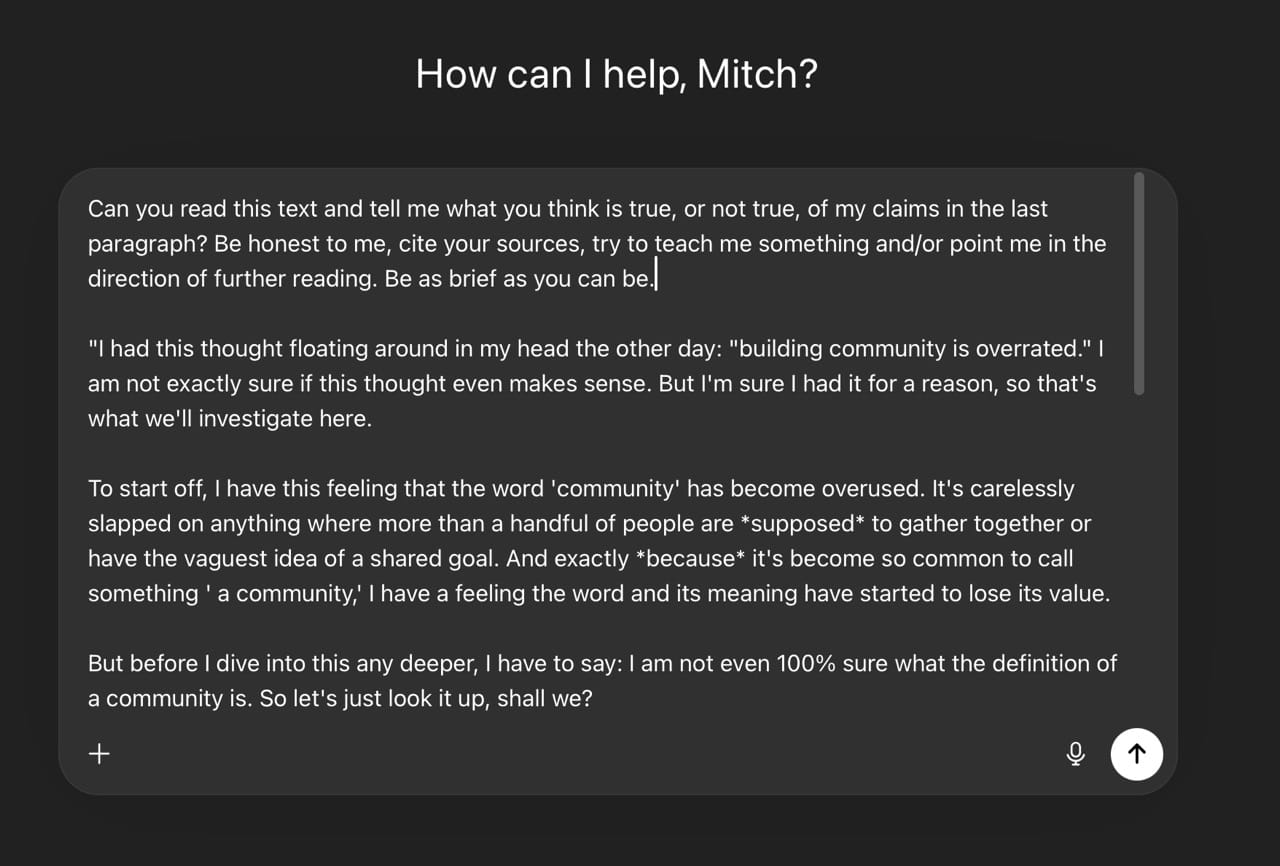
I'm back, thanks for waiting. So the first thing it tells me is that "research consistently shows community is highly predictive of well-being and outcomes." but I see no surprises there and am not saying that's not the case. But let's dive a little deeper because, apparently, there's a thing called "semantic bleaching" where words lose precision as they are overused in broad contexts. And there is evidence that supports both marketing and politics use deliberately constructed language to drive loyalty and engagement, as well as increase a perceived shared identity and compliance. I haven't read the original sources, because I'm thinking through this in a flow-state and am not writing a scientific essay, but they are Muniz & O’Guinn (2001) and Tajfel & Turner (1979) if you want to look them up.
I am getting some pushback from the bot on my implicit claim that “community is overrated” but I was not saying that, I am saying that building community has become overrated. But then it also puts the words in my mouth directly after, and tells me that what I'm arguing for is that “the label 'community' is over-applied to low-cohesion groups, and used rhetorically to signal value that may not actually exist.” Awesome, now I no longer have to think about a definition myself. Perhaps I shouldn't have thrown my thinking in ChatGPT so fast... Oh well, at least we're getting somewhere now.
So what exactly am I bothered about? Why did this feeling of building communities being overrated in 2026 creep up on me like that? Was it just a moment of bitter grumpiness, or did something I experienced strike a chord in order for me to suddenly connect some dots? Back to Wikipedia, the community building page specifically now, where a quote by sociologist David Brain half-way down the page strikes me: "Community is something we do together. It's not just a container." It appears he said this during a presentation at the University of Miami School of Architecture in 2004 and I think those words are still true 22 years later. In fact, I think the need for community, a sense of belonging, a version of kinship with peers, has become even more important than it probably was back then.
Our world has become smaller, more connected, faster paced, with less time to reflect, relax, and be real humans. There's an expectation of immediate access to each and everyone of us that is very difficult to escape from, that might seem like we're more in tune with each other but leaves no space for ourselves. As a result, we have to be careful not to become empty shells floating around our globe unable to connect with our own identities and therefore not being able to truly connect to the people around us.
Building community in a physical space, for people that have similar goals, ambitions, and views on the world, provides our tired souls with a version of security and certainty that is hard to come by these days. I'd say its very necessary we continue building communities for places, people, and things we find important. I'd also say we should therefore use the concept more sparingly, for things that don't require it.
Maybe it's just me. But I can belong to only so many places. As David Brain pointed out: community is an activity, not a thing, which means it requires energy to build and maintain. I have no desire to become part of the community around my local bank, or the post-office. To me, joining a community comes with attaching that membership to your identity. I see no use for doing that for things I care too little about and only meet utilitarian needs in life. Even things that might sound like they deserve a community, like the new creative hub for people that like drawing mythic animals (I'm just spitballing here), should be careful declaring they have one.
In fact, I'd argue a community is earned, not built. Just because you think your idea is the most important thing and people should be a part of it, does not mean you immediately deserve their attention. The effort you spend on your community should be reflective of the commitment you're asking from people.
Exactly because community membership is so important for our well-being as humans, we need to be very conscious of which ones we join. For if you join the wrong one you might end up wasting your time, energy, and possibly your identity. That's worded rather definitively, and might sound exaggerated, but viewing it from this angle puts the member at the forefront of the community they should form.
Provide your value first, then allow people to excitedly buy into that. Do that long enough, and you might gather enough people that support the goals you preached and turn those into shared goals. Do that well and they might end up carrying the whole thing for you. It all starts with the individual though. The collective will be stronger for it.
The moment your guidance or control over the thing you started is no longer required, and the group can broadly direct itself, that's when you might've broken into community-territory. Anything before that is self-glorification and an overestimation on how important you and the things you do are.
Just you, me, and some occasional notes from the field. No spam.
Member discussion