
Define the shape of your work

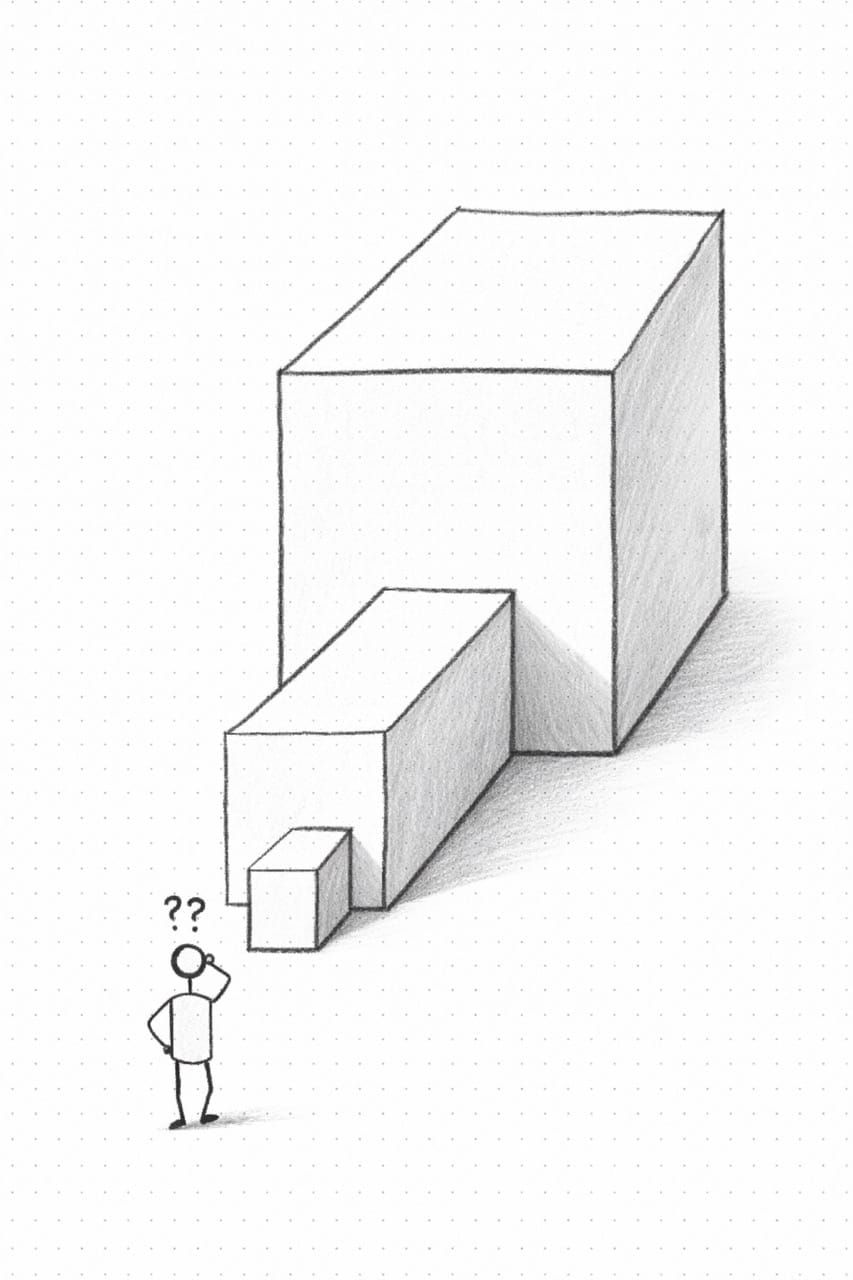
Before I start working on things, I like to get an idea of 'the shape' of the work I'm about to do. It's about answering the question "What should this work look like, at the end of this process?" When I'm writing, for example, my work can take on the shape of a quick note, a blog post, an essay, a toolkit, maybe even a book, etcetera. Determining the shape of the work, determines the amount of effort it should take.
Obviously, a quick note can turn into a blog post, which might turn into an essay, that could end up becoming a book, but point is that you should typically follow this exact process. You have to be honest with yourself about the project you are starting. Or in our newly learned jargon, about "the loop you are opening." Your goal is to keep this loop as small as possible and only making it bigger when it absolutely needs to be.
In our writing example, this means that your aim shouldn't be to 'write a book.' Books don't emerge out of thin air. Good books need good ideas, that have been good ideas for a while. Ideas that stood the test of time, were reflected on a little, perhaps even adjusted in the process. Writing a book is a gigantic loop that requires a level of commitment you have to be certain about.
Instead, it's much better to 'write a quick note' and get that initial thought out of your head, onto the paper, and calling that 'done.' That's a tiny two-minute loop, that can then be closed, and stored for later reference. Do you find yourself returning to that note over time? Then it might be warranted to open a slightly bigger loop of turning that note into a blog post. Blog posts are a nice step up because they are a public display of that note. They need to be a little more fleshed out, in order for them to be understandable by people other than yourself. And because blog posts are public, they should be getting some feedback too. If that's the case, awesome. Now you can figure out if there's more to explore that warrants a bigger 'shape' and does, in fact, deserve to be a book.
Determining the shape of the work, determines the amount of effort it should take.
Are you still with me? The above took me a while to see clearly. Mostly because I kept looking for the problem in the ideas themselves. I assumed that if something wasn’t moving forward, the idea must be wrong, or at least not good enough yet. In reality, the ideas were often fine. What was broken was the container I was trying to shove these ideas in.
Most creative frustration doesn’t come from a lack of inspiration. It comes from good ideas placed in forms that don’t support them. As a result, expectations of what the result should be stay vague or become far too great to ever meet. And let me tell you, it's super demotivating to see ideas slowly fizzle out because they were not allowed to be what they needed to be.
Good idea, wrong container
When work feels good, it’s rarely because the subject matter is perfect. It’s because the shape you're making that work for fits. The tempo matches the energy. The scope matches the required attention span. The time you spend working on it respects the fact that focus is temporary and fragile, and you're spending it sparingly.
Momentum, when it appears, is a narrow window. You feel it when ideas connect faster than you can write them down, when your attention sharpens instead scatters. It's a wonderful state to be in. It even has an official name, flow state, and it occurs when your skills and the challenge at hand are well matched. Sadly, it's also a temporary state. So we best make use of it while we can, and aim to work in short loops to ensure that, once this state wanes off eventually, we at least have something done. If a loop stays open too long, you can feel the intensity slowly decreasing. Not because you suddenly lost motivation, but because attention doesn’t survive indefinite ambiguity. That's not just you, that's just human biology.
So when the container is wrong and the feedback loops too long, even strong ideas start to dissolve over time. That probably doesn't mean you stop working. You just stop feeling forward momentum. And without that feedback, progress becomes harder to recognize, even when the effort is real.
Subscribe to continue reading
Advance