
Why this framework exists

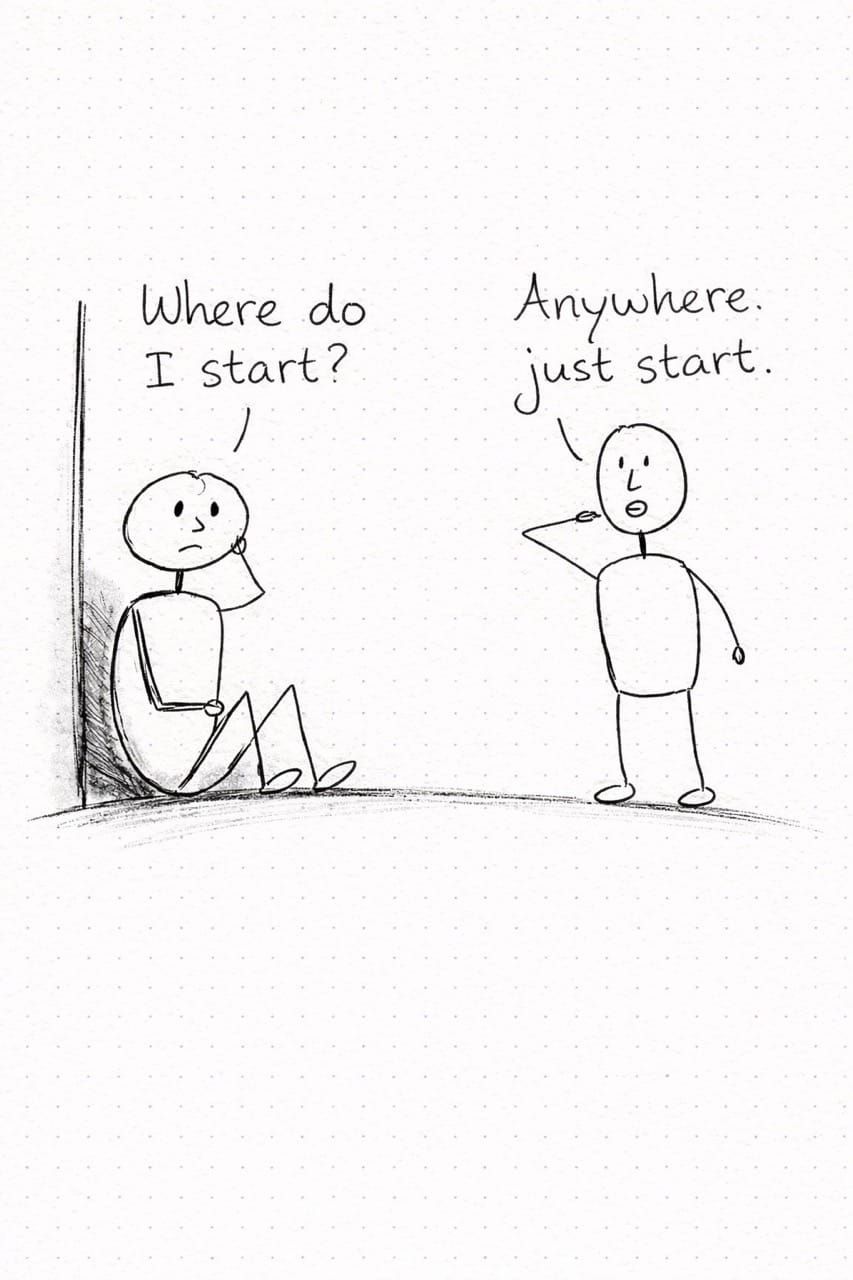
If you are anything like me at all (and if you're reading this, you probably are), you don’t have trouble coming up with ideas. You can see possibilities everywhere. Plus you roughly have an idea on how to execute them too. Awesome, of course, but sometimes that's not enough. Especially in a world that's growing more complex, busier, fast-paced all the time. It's hard to keep up, whilst staying true to yourself, and also finishing things in that chaos.
So starting things is relatively easy. Everything you need for that in the world pretty much exists. Where things start to wobble is a little later in the process. Usually in the moment where an idea asks for commitment instead of enthusiasm. That’s when the doubts creep in. You start running simulations in your head. What if this doesn’t work? What if it’s not good enough yet? What if there’s a better, smarter, version of this plan, this idea, of yourself, you should wait for? Before you know it, you’ve talked yourself out of something you were genuinely excited about. And the result? Wasted time, energy, and sometimes, if that's your goal, financial potential.
Overthinking is avoidance
The irony is that this doesn’t come from laziness or lack of ambition. It comes from being able to see too many angles at once. You notice the flaws early. You anticipate outcomes that haven’t happened yet. And because you care about doing things well, you freeze before you’ve actually done something and gathered any real-world evidence.
So the problem isn’t a lack of ideas or skill. It’s that you treat too many decisions as if they are final, when they could simply be small, temporary moves that generate feedback and momentum.
Feedback is the observable result that follows a closed loop. It can take the form of a response from other people, measurable results, or a clearly defined constraint that becomes visible after completion.
Feedback only exists after something is finished and exposed to reality. Thinking about possible outcomes is not feedback.
Most creative people don’t fail because their work lacks quality. They fail because their work stays too far removed from real-world value. Ideas remain ideas. Projects stay in draft. Decisions get optimized before they ever touch reality.
Advance exists to shorten that distance.
Money and survival
Most of us live in a capitalist society. And much of what we do is ultimately driven my the need to sustain ourselves. That sustainability is expressed and measured in money. That's just the way things are and that's fine, as long as you are able to turn your ideas into something that generates it. Just so you can keep doing what you love doing. If you are in a creative field, this challenge is especially salient, for the path to sustainability is different for everybody and usually relies on mechanisms that are opaque and therefore difficult to master.
The way to achieve that mastery is not by chasing revenue, but by forcing your work into feedback loops where value can actually be tested. The loop is the most powerful way to think of this process, because it defines it as a circle that allows you to come back and adjust based on what you learned, instead of a linear process that implies decisions are permanently set in stone and irreversible. Linear thinking puts a lot of pressure on doing the right thing, right now, whereas circular thinking focuses much more getting things done consistently, making iterative improvements along the way.
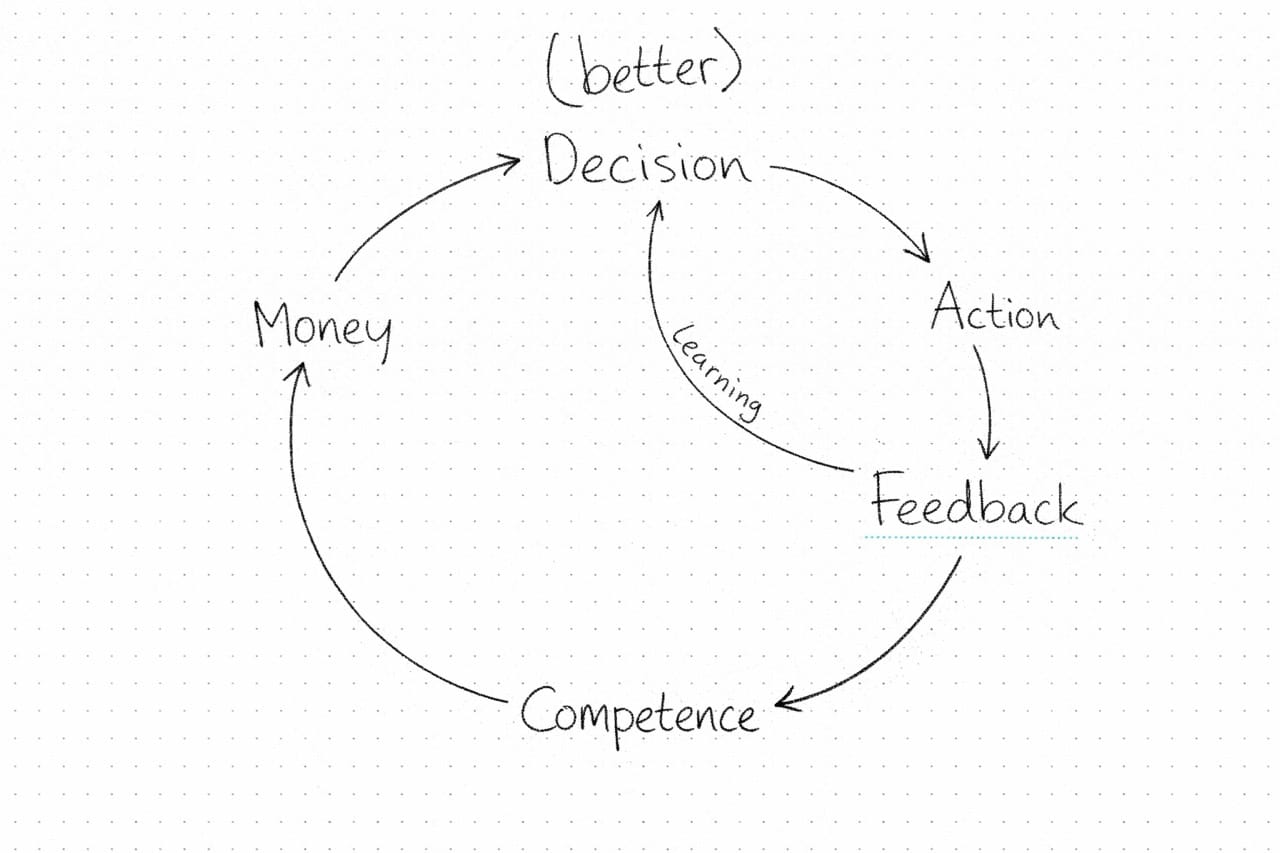
When decisions lead to action, action leads to feedback, and feedback compounds into competence, money becomes a byproduct rather than a goal. An inevitability instead of a challenge. If your work never makes any money, this framework will surface that. If it does, it helps you move closer to it with less wasted effort.
A loop is a defined unit of work or decision with a clear end condition that produces an observable result when completed.
A loop begins when you commit to a specific outcome. A loop ends when the predefined condition of 'done' is reached. The result that follows completion creates feedback.
A "feedback loop" simply means this: action leads to an outcome, and that outcome informs your next action. If there is no clearly defined end, it is not a loop. It is ongoing activity.
You are already living in loops. Every email you send, every proposal you submit, every project you start creates one. Some close quickly. Others remain open for weeks, months, or longer.
This framework does not invent loops. It makes them visible and structural so they can be closed deliberately.
Momentum into nothing
I started paying attention to this pattern in myself years ago. Mostly because, despite my best efforts to 'do better next time,' I kept ending up in the same place of disappointment and dissatisfaction.
I can be busy, engaged, working on multiple things that all feel meaningful in isolation. New ideas keep appearing, systems to execute on them keep getting refined, plans keep evolving. "Well, that sounds great," you might think. And from the outside, it can definitely look like momentum. And the tricky part is that from the inside, it feels like movement too. At least at first.
The problem isn’t a lack of ideas or skill. It’s that you treat too many decisions as if they are final, when they could simply be small, temporary moves that generate feedback and momentum.
But over time, something subtle shifts. The work doesn't stop, but it stops landing. Be honest with yourself and maybe it starts feeling a little empty too. As if you're working just to work on things but ultimately not building anything. Decisions keep getting postponed. Projects stay open and inconclusive. Feedback never really arrives, because nothing is finished enough for the world around you to respond to. So instead of building something with clarity, you're just collecting noise.
Focus on clarity, not ideas
What I eventually realized is that this isn’t an 'ideas problem.' Creative people rarely run out of ideas. If anything, ideas are the one thing we have in excess. The real issue is that too many things get started, not properly finished, and stay open at the same time.
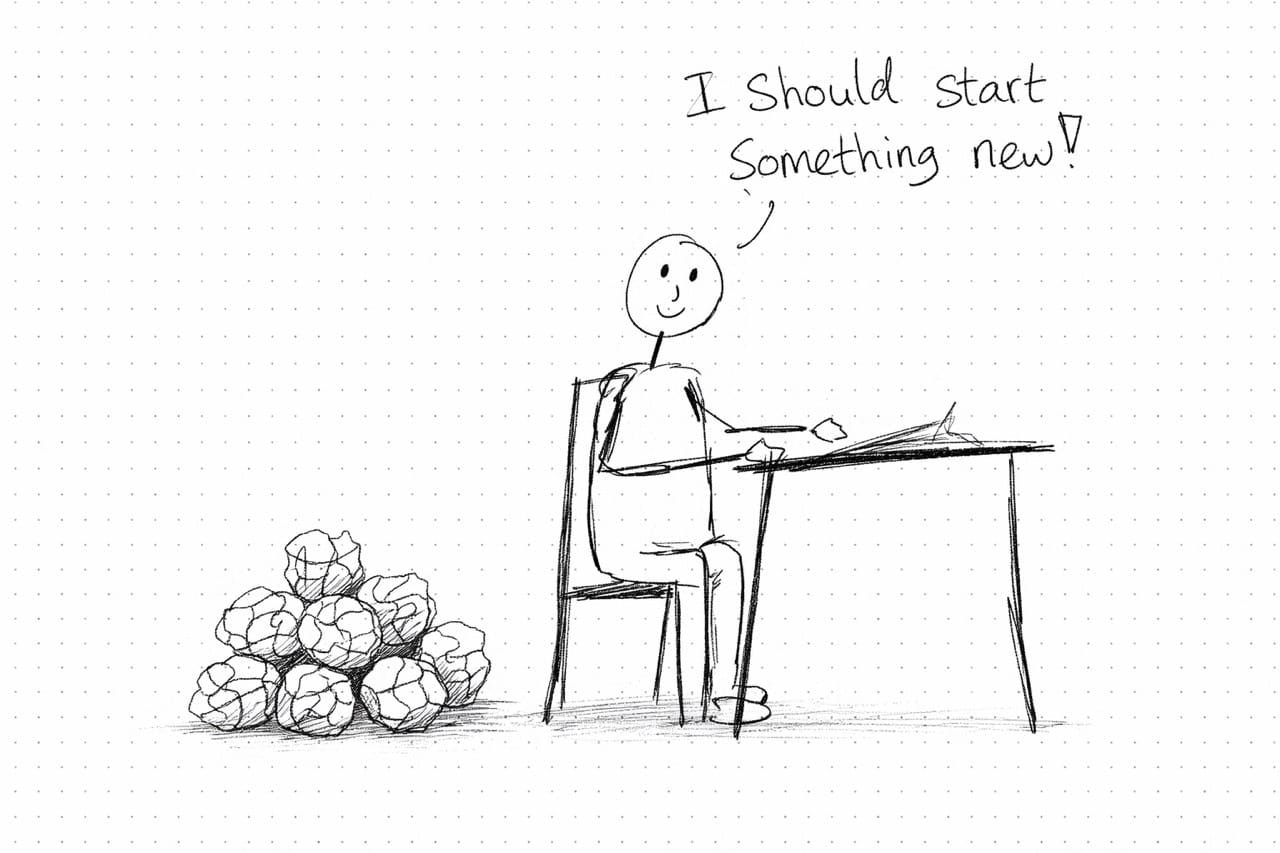
Now, I would argue that’s not immediately uncomfortable or undesirable. In fact, it often feels productive. Open projects feel full of potential. Unmade decisions can even feel like flexibility "I can take this so many directions, the potential is crazy!" you hear yourself saying. Keeping options in a pending state feels mature, in a way, because it feels like you have control over your life. But there’s a cost to that state, and it’s one you only notice once it’s been compounding for a while.
Advance grew out of that realization. Not out of a desire to remove uncertainty, because I don’t think that’s realistic or even desirable, but out of the need to learn how to move with uncertainty instead of constantly waiting for it to resolve. Because in my experience, clarity almost never shows up before you act. It shows up afterwards, if it shows up at all. And we have to keep living with or without it regardless.
Clarity means having enough concrete information to define the next action. It does not mean certainty about the long-term direction.
In this framework, clarity appears after a loop closes and produces feedback that narrows your options.
Learning is cyclical
What has worked for me, again and again, is smaller than I'd like it to be. It’s not about seeing the whole path or making the perfect call. It’s about taking one step. Just one. And only after that step is taken, looking up again to see what the next one might be.
The framework behind Advance is built on a simple idea that took me a long time to actually accept: learning is cyclical.
In this framework, learning means this: you take a concrete action, that action produces an observable result, and the result differs in some way from what you expected.
The gap between expectation and outcome updates your understanding. That's learning.
Without action and a resulting outcome, learning has not occurred.
To turn this realization into something that's practical and applicable in real life, I developed this decision framework. Its core mechanism is the Advance Filter, introduced in Chapter 5. Before we get to that, I want to take some time to make explicit the challenges we face in daily life, where this framework might prove beneficial. The core is relatively simple though: your goals are are achieved by aiming to learn as much as you can. About the world, about yourself, and how the two work together. In order to learn, you need feedback. Feedback is gathered through loops. The shorter you make your loops, the faster you gain feedback, the more you learn, the quicker you achieve your goals.
Without closed feedback loops, there is no learning. Not because you’re not smart enough to understand what’s going on, but because you never give reality a chance to answer.
So think of it like this: it is your duty to turn your thoughts and ideas into action. As long as things stay hypothetical, you remain in a state of theory. In anticipation. In possibility. Finishing something, even in a rough or imperfect form, creates evidence. Evidence that you're doing something, actually have valuable ideas (reality check: do you have a clue how many people actually don't have all those ideas, and are fine with that?), and that you are able to execute on them. Evidence shows you what works, what doesn't, and what surprises you along the way. Over time, that builds a kind of competence that’s hard to fake. The kind that doesn’t come from planning better, but from having seen things play out.
Become a serial finisher
That’s what this framework is for. Not to help you think better, but to help you finish more things. Not to optimize your output, but to help you focus on learning instead. This framework does not promise any specific results, but to help you create conditions where progress can actually occur.
Advance helps you notice when thinking turns into overthinking and slowly turns into avoidance. It helps you lower the stakes of decisions so movement becomes possible again. It encourages working in short, deliberate loops rather than long, abstract plans that never quite end. And maybe most importantly, it treats uncertainty as a given, not as a flaw you need to eliminate before you’re allowed to move.
This isn’t a productivity system. We're not interested in efficiency for its own sake, or in turning your work into a set of metrics. It’s a way of working that values movement over certainty, progress over outcomes, and responsibility over keeping every option open.
You don’t need to know where you’re going. You just need enough clarity to take the next step and simply go. And trust me, in practice, that turns out to be enough more often than we’d like to admit.
Advance
Toolkit map
Just you, me, and some occasional notes from the field. No spam.
Member discussion