
You're too competent to finish things

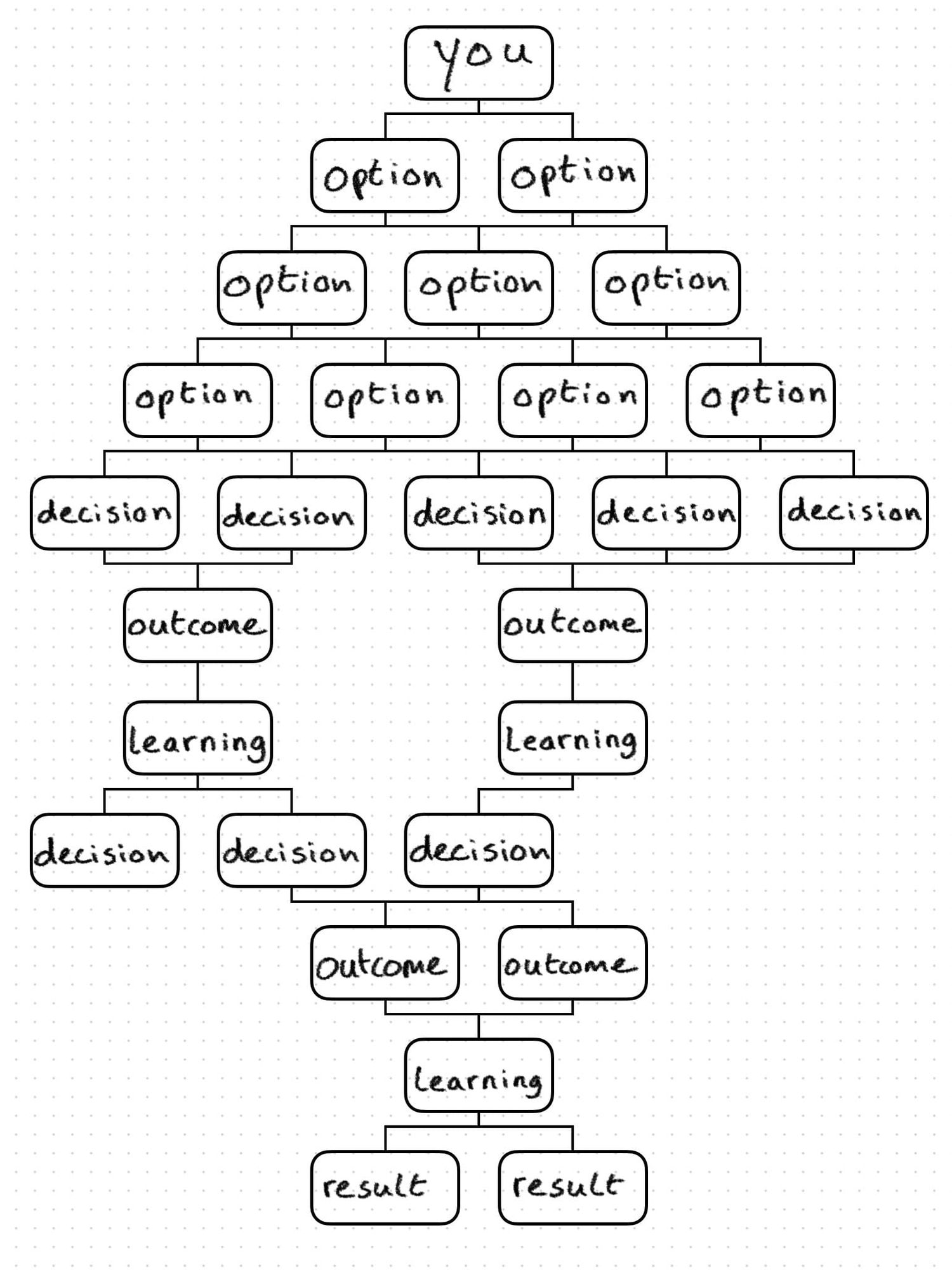
When I look back at the moments where I felt most blocked, it’s almost never because I lacked skill, discipline, or ambition. And when I talk to other creative people who feel the same kind of friction, they report the same thing. If anything, the pattern points in the opposite direction. We get stuck because we can do too much.
Too many skills.
Too many interests.
Too much awareness of nuance.
This chapter isn’t about motivation or grit. It’s about what happens when your capabilities outpace your ability to create closure for yourself.
The beginner mindset
Beginners move fast. Not because they know what they’re doing, but because they don’t yet see everything that could go wrong. They don’t feel the full weight or consequences of their actions. Beginner loops are small, and therefore feedback is pretty much immediate. A beginner's path, while uncertain, is simple enough to walk on without much hesitation. Forwards is the only logical option. At this early stage, not many problems show up yet.
The problems we are discussing here appear later. After some experience is gained. After our taste has developed a little more. After you’ve learned to see the trade-offs too, instead of just the absolutes.
You understand how things work now, once graduated from that beginner stage. You can anticipate some second-order effects. You can argue both sides of a decision convincingly. You're able to see some nuance in the world, and understand it truly is multiple shades of grey with black and white as rare extremes. As a result, very little feels obviously wrong anymore. But at the same time, very little feels obviously right either. And because of that, closing something starts to feel heavier than opening it.
Everybody knows what a decision is, but in Advance we use the word a bit more broadly.
In this framework, a decision is the point where something becomes actionable. Where an idea gains an end condition, and a loop begins. A decision is what turns possibility into direction.
Your work doesn’t move forward through thinking alone, but through decisions that can actually finish.
So things stay open. Not because you’re lazy. Not because you’re afraid of the effort required to finish things. But because finishing something now means giving up the possibility of finishing it better later.
The weight of the open loop
I’ve personally felt this most clearly when building my systems. Websites, note-taking, archiving, frameworks, all structures meant to support other work. I can get completely absorbed in thinking about how everything should connect, how it should scale, how it could be made more elegant or future-proof. And while I’m doing that, it genuinely feels productive. Until, at some point, I notice something’s off.
Weeks have passed. The system has become more refined, sometimes even perfected. But the original purpose has faded. I have trouble answering a simple question: what was this actually meant to support? The work was done and I kept things moving, but I drifted away from the reason the work existed in the first place.
From the outside, this still looks like progress. And technically, it is. But internally, something else starts to accumulate. Open loops. Mental background processes causing a kind of fragmentation that’s hard to notice until it’s already there.
You don’t feel it immediately. Not consciously, at least. And that's very understandable, given how slowly it starts to show. You'll notice it in the way you talk, jumping between threads without quite landing. In how you explain your choices, layered and nuanced, but somehow unfinished. In how you receive feedback, intellectually engaged, yet either strangely untouched by it, or sometimes even frustrated, because there’s nothing concrete for that feedback to push against. The issue isn’t the effort you put in things. It’s the closure you're denying yourself.
Subscribe to continue reading
Advance