
The Ricoh GR1-D: a minimal full-frame 28mm camera concept

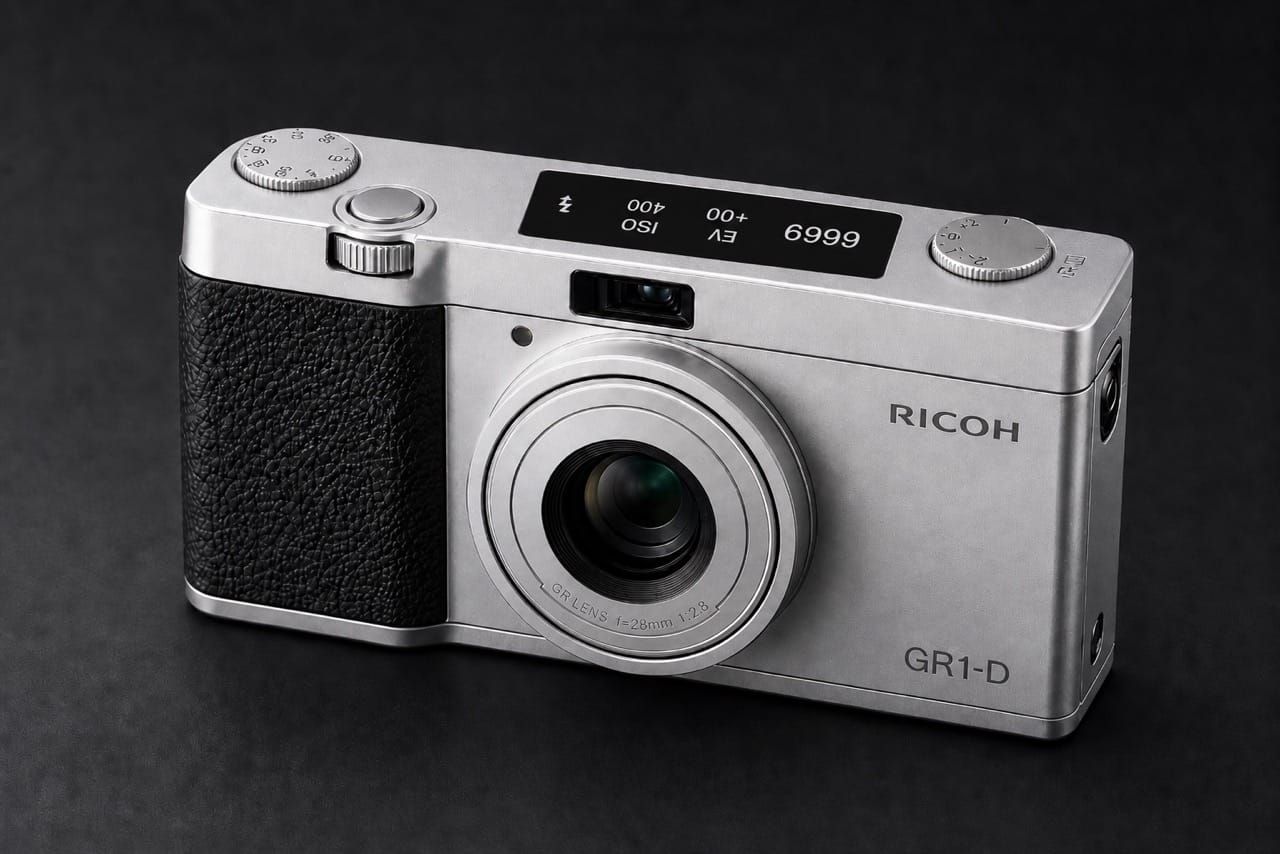
Ricoh needs to remake the GR1 as a digital camera. Call it the Ricoh GR1-D. Make it a simple camera designed to take photos whenever you're ready. Nothing else. Make it a tool that does one thing and does it extremely reliably, without ever failing, slowing, or stuttering, forever.
A tool for photography purists who care about capturing moments. For people who learn to see the world as if through a lens, and recording it instinctively and automatically. A tool that not only becomes an metaphorical extension of you but almost a literal one. To the point that one of your hands might take on the shape of the camera body. Connected in a way that just feels right.
To achieve this, Ricoh could build a full-frame, fixed 28mm camera designed for one thing: taking photos, fast. My dream, while ambitious in today's economy, I'm sure, I also believe to be somewhat realistic. If we accept the limitations it imposes.
First principles: strip it down deliberately
- No video. Remove it entirely. No microphones, no audio chain, no hybrid compromises.
- No IBIS. Keep the system mechanically simple and spatially efficient.
- No feature-heavy software layer. The camera should be fast because there’s nothing slowing it down.
- Keep the processor modern where it matters (sensor readout, autofocus, image pipeline), but hide all complexity from the user.
Interface
- No rear screen but a status display on the top showing shot count, ISO, battery, focus mode, and flash mode.
- Use a high-quality EVF for framing, exposure, and focus confirmation.
- Physical controls for everything essential: aperture, exposure compensation, ISO, flash.
- Minimal or no menu dependency.
Optics
- A fixed 28mm lens, designed for full-frame digital without aiming for perfection. A mix between performance and character is what we need here.
- Accept some optical imperfection if it enables a more compact, responsive system.
- Integrate a leaf shutter into the lens for silence, compactness, and simplicity.
Body
- As compact as possible, but not artificially constrained to GR size.
- A unibody aluminum chassis that acts as structural frame and thermal sink.
- Internal thermal path designed to move heat from sensor and processor into the body.
- Optional vapor chamber if needed for stability under sustained use.
Performance priorities
- Instant startup.
- Minimal shutter lag.
- Fast, reliable autofocus (with strong snap/zone focus as a core mode).
- Responsive shot-to-shot performance.
Tradeoffs are explicit and accepted
- Slightly larger than a modern GR if need be.
- Slightly higher cost due to its niche positioning.
- No image review on-device.
- Reduced flexibility in exchange for speed and clarity.
Some of these things might seem outrageous in the current year. This camera will look sparse and underpowered to many. But it would likely develop a cult following among a specific group: people who want to take photos and nothing else. Give them pure ruggedness in a compact, beautiful industrial design, package.
The goal is not to compete with modern feature-rich cameras. The goal is to build a focused photographic tool:
A camera that removes decision overhead, stays out of the way, and is always ready to take the shot.
Not a device you manage. Not a hybrid of competing functions. Just a camera.
Ricoh, if you're reading this: reach out and I'll gladly hear from you why my idea is stupid. Then try to convince you why it is not.
Just you, me, and some occasional notes from the field. No spam.
Join the conversation